Spectacled Bears Near Machu Picchu: Wildlife Inside the Historic Sanctuary


On this page
Last updated: October 2026 · Written by the Machu Picchu News editorial team · Editorial review: team with on-the-ground knowledge of Peru
Spectacled bears live in the forests around Machu Picchu, and monitoring by Peru’s protected-areas agency has detected dozens of them inside the Historic Sanctuary of Machu Picchu. Bears have occasionally been filmed on the citadel’s terraces, but sightings are unpredictable, and the species is protected in Peru.
Quick answer: Yes, spectacled bears, also called Andean bears, live in the Historic Sanctuary of Machu Picchu. Monitoring by Peru’s protected-areas agency, SERNANP, puts the local population at about 70 bears as of 2026. Bears have been filmed on the terraces of the Inca citadel, but sightings are rare and cannot be guaranteed.
What is a spectacled bear?
The spectacled bear (Tremarctos ornatus), also known as the Andean bear, is the only bear species in South America. It lives only in the Tropical Andes, from Venezuela to Bolivia, at elevations of about 200 to 4,750 meters, according to the International Association for Bear Research and Management. It takes its name from the pale markings that often surround its eyes.
The species is mostly vegetarian: plants make up to 90% of its diet, with bromeliads and palms among its common foods. Adults weigh 34 to 175 kg, and males are about one-third larger than females.

| Fact | Detail | Source |
|---|---|---|
| Scientific name | Tremarctos ornatus | IBA |
| Status | Vulnerable (IUCN; Peru’s Supreme Decree 004-2014-MINAGRI) | IBA; SERFOR via Andina |
| Range | Tropical Andes, Venezuela to Bolivia | IBA |
| Diet | Up to 90% plants | IBA |
| Weight | 34–175 kg | IBA |
| Population in the Machu Picchu sanctuary | About 70 bears (2026 monitoring) | SERNANP via El Búho |
Are spectacled bears endangered?
Spectacled bears are classified as Vulnerable, both by the IUCN and under Peruvian law. Peru’s forestry and wildlife agency, SERFOR, says hunting the bear is prohibited, as is its “capture, possession, transport or sale”. SERNANP says Peru has the largest population of the species in South America (Andina, 2020).
Older sources sometimes describe the bear as “endangered.” Its current status in Peru and with the IUCN is Vulnerable. The main threats are habitat loss and fragmentation, farming expansion, poaching and retaliation after damage to crops or livestock.
How many bears live around Machu Picchu?
Estimates of the spectacled bear population in the Historic Sanctuary of Machu Picchu have grown as monitoring has improved:
- 2014–2015: a survey by SERNANP and the Wildlife Conservation Society found signs of bears in more than 95% of a 368 km² study area (WCS, 2017).
- 2023: 100 camera-trap stations, set by the group Spectacled Bear Conservation with SERNANP, identified up to 21 individual bears.
- 2024: the first satellite collars were fitted on two adult females in the Wiñayhuayna area, as part of a plan to install 10 collars.
- 2022–2024: SERNANP reported 49 independent bears and four collared bears.
- 2026: monitoring puts the population at about 70 bears using more than 87% of the sanctuary.
The figures come from different methods and periods, so they show a trend in knowledge rather than a population count over time.

Can tourists see spectacled bears at Machu Picchu?
Tourists occasionally see spectacled bears at Machu Picchu, but sightings cannot be predicted. Bears have been filmed going down the citadel’s terraces in 2015 and 2017, and in 2021 Ministry of Culture staff filmed a mother and cub climbing the terraces after the site’s pandemic closure, according to reports in Andina and Última Hora.
In 2017, the then head of the Machu Picchu archaeological park, Fernando Astete, described a bear crossing from the Guardhouse over the terraces to the Inca Bridge, usually before noon (Andina, 2017). Machu Picchu News found no report of bears at the citadel itself between 2022 and 2026; the most recent sighting reported, in May 2026, was in the forests near the railway.
Other wildlife in the Historic Sanctuary of Machu Picchu
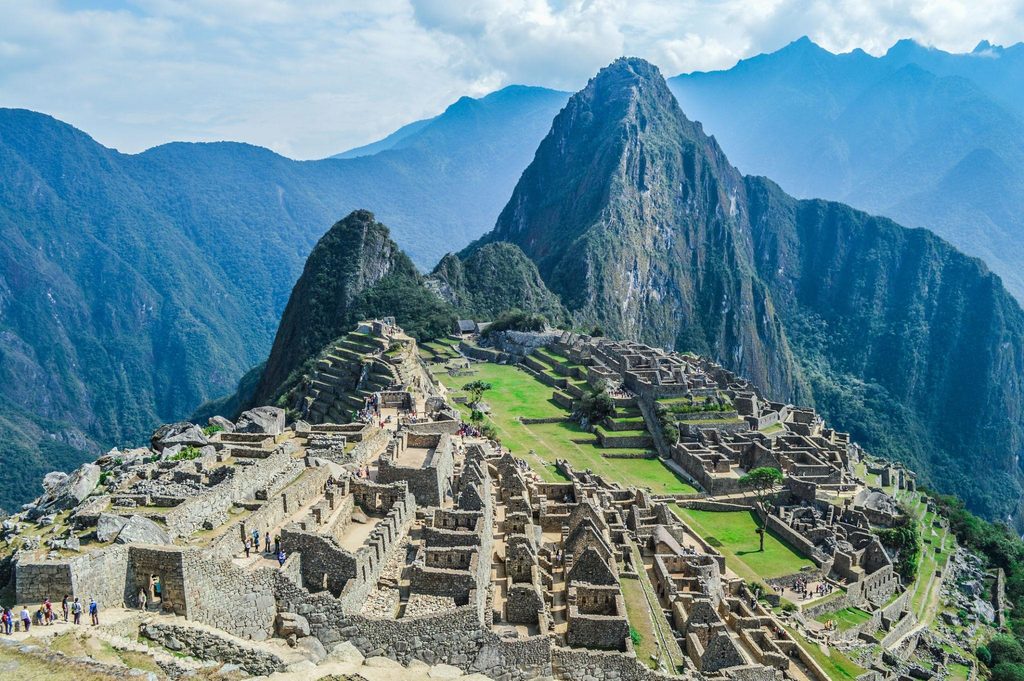
The Historic Sanctuary of Machu Picchu protects 32,592 hectares of mountains and cloud forest around the Inca citadel. It was created on January 8, 1981 (Andina, 2026), and UNESCO inscribed it in 1983 as a mixed cultural and natural World Heritage site (UNESCO).
The sanctuary’s 2015–2019 master plan diagnosis, prepared by SERNANP and DDC Cusco, recorded 443 bird species, 423 orchids, 77 mammals, 26 reptiles, 16 amphibians and 377 butterflies (Plan Maestro diagnosis, 2014). A Ministry of Culture publication calls the Andean cock-of-the-rock (Rupicola peruvianus) the sanctuary’s “emblematic and most representative species” and the spectacled bear “the symbol” of the sanctuary (Ministry of Culture).
Conservation in the sanctuary
The Historic Sanctuary of Machu Picchu is managed jointly by SERNANP and Peru’s Ministry of Culture. In March 2026, both approved new management plans running to 2031, according to El Peruano; earlier coverage named the Andean bear among the emblematic species the plan aims to protect.
Fire and the railway are two current concerns. In August 2026, a forest fire burned about 1.5 hectares of primary forest at kilometer 107.4 of the railway, and SERNANP rangers helped put it out, according to EFE via ABC. SERNANP says the railway is not a significant barrier for bears and is working with the rail operator on signs and alert protocols to prevent collisions.
In Aguas Calientes (Machu Picchu Pueblo), the Inkaterra Machu Picchu Pueblo Hotel runs a rescue project for Andean bears that began in 2001, when the sanctuary administration placed a cub in its temporary custody (Inkaterra). It is a private project.
Are spectacled bears dangerous to tourists?
Spectacled bears are generally shy and avoid people. WWF states that there are no recorded attacks on humans, and recommends staying calm, moving away slowly, keeping at least 5 meters of distance and taking extra care around a mother with cubs (WWF). Guidance from Colombia’s Chingaza National Park adds: do not corner a bear, and leave it an escape route (Semana, 2020).
Machu Picchu News found no official SERNANP guidance on bear encounters. The site’s code of conduct prohibits feeding wild animals, disturbing fauna and leaving the established routes. In 2017, the head of the archaeological park said bears tended to approach tourists in search of food, which makes the no-feeding rule especially important.
Frequently asked questions
Are there bears at Machu Picchu?
Yes. Spectacled bears, also called Andean bears, live in the Historic Sanctuary of Machu Picchu. SERNANP monitoring puts the population at about 70 bears as of 2026, and bears have occasionally been filmed on the terraces of the Inca citadel.
What kind of bear lives near Machu Picchu?
The spectacled bear (Tremarctos ornatus), the only bear species in South America. It lives in the Tropical Andes from Venezuela to Bolivia, eats mostly plants and is classified as Vulnerable by the IUCN and by Peruvian law.
Can I see a spectacled bear on my visit to Machu Picchu?
Possibly, but sightings are rare and cannot be guaranteed. Bears have been filmed at the citadel in 2015, 2017 and 2021. Visitors must stay on the official routes, so the best chance is to keep watch from the route and never approach or feed an animal.
Is Machu Picchu also a natural protected area?
Yes. The Historic Sanctuary of Machu Picchu, created in 1981, protects 32,592 hectares of mountains and forest. UNESCO inscribed it in 1983 as a mixed cultural and natural World Heritage site, and it is managed by SERNANP and Peru’s Ministry of Culture.
How should I behave if I see wildlife at Machu Picchu?
Keep your distance, stay on the official route, stay quiet and never feed or disturb animals, which the site’s code of conduct prohibits. If you see a bear, move away slowly, keep at least 5 meters away and give it an escape route, as WWF recommends.
Update
SERNANP continues to monitor spectacled bears in the Historic Sanctuary of Machu Picchu, and population estimates may change as new data are published. Machu Picchu News will update this article when SERNANP or Peru’s Ministry of Culture releases new results.